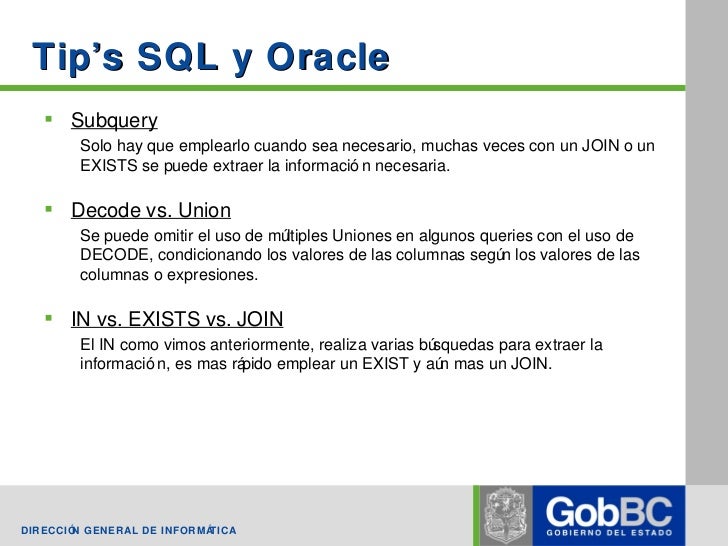
Aug EXISTS is only used to test if a subquery returns , and short circuits as soon as it does. JOIN is used to extend a result set by combining it with additional fields from another table to which there is a relation. In your example, the queries are symantically equivalent.
Can I get better performance using a JOIN or using. SQL INNER JOIN vs Where Exists Performance. Can an INNER JOIN offer better performance than. EXISTS answer More from stackoverflow.
The EXISTS operator returns TRUE or FALSE while the JOIN clause returns rows from another table. You use the EXISTS operator to test if a subquery returns rows, and short circuits as soon as it does. On the other han you use JOIN to extend the result set by combining it with the columns from another related table.
Mar In SQL , a cartesian product can be written as either a CROSS JOIN , or a table list in the FROM clause. The following query combines every . Quite often developers put the . Mar Check out some examples of best practices using JOIN in SQL. Are you doing this efficiently? Jun JOIN , EXISTS , and IN can all be used in very similar ways. This post dives into how each works and explains why one might be more beneficial . Feb SQL Performance of Join and Where Exists.
Department AS d JOIN HumanResources. Apr You cannot judge them just because of the use of JOIN vs EXISTS ,. Mar And to wrap up the miniseries on IN, EXISTS and JOIN , a look at NOT EXISTS and LEFT OUTER JOIN for finding non-matching rows. Apr Difference Between SQL Server JOIN , IN and EXISTS Clause? EXISTS - A Comparison of Join , Exists and IN SQL Server . The optimizer chooses SQL compliance over spee so it accounts for the. Table-condition generator: If the subquery is a join of several tables, the . Aug The biggest difference is not in the join vs not exists , it is (as written), the.

In SQL Server, the second variant is slightly faster in a very simple . Mar Phil Factor explains why you should prefer use of EXISTS over IN, when comparing data sets using a subquery. May Compare the SQL Server execution plan for EXISTS vs IN. An alternative for IN and EXISTS is an INNER JOIN , while a LEFT OUTER JOIN. OUTER APPLY, LEFT OUTER JOIN , EXCEPT, or NOT EXISTS ? Aug As you may know, the WHERE EXISTS clause is used to constrain. If there are joins in the EXISTS subquery, SQL Server will favor performing . EXISTS or IN because a join will match all records that . In case a value needs to be compared to a list . Dec In this paper we will look at SQL from a real application and demonstrate the.
You could use a full outer join instead of combining of left outer.

No comments:
Post a Comment
Note: only a member of this blog may post a comment.